

Genes, Environment and Endometriosis
A simple explanation of why endometriosis may behave differently from one woman to another


The concept at a glance
A research model of interacting influences, not a proven causal chain
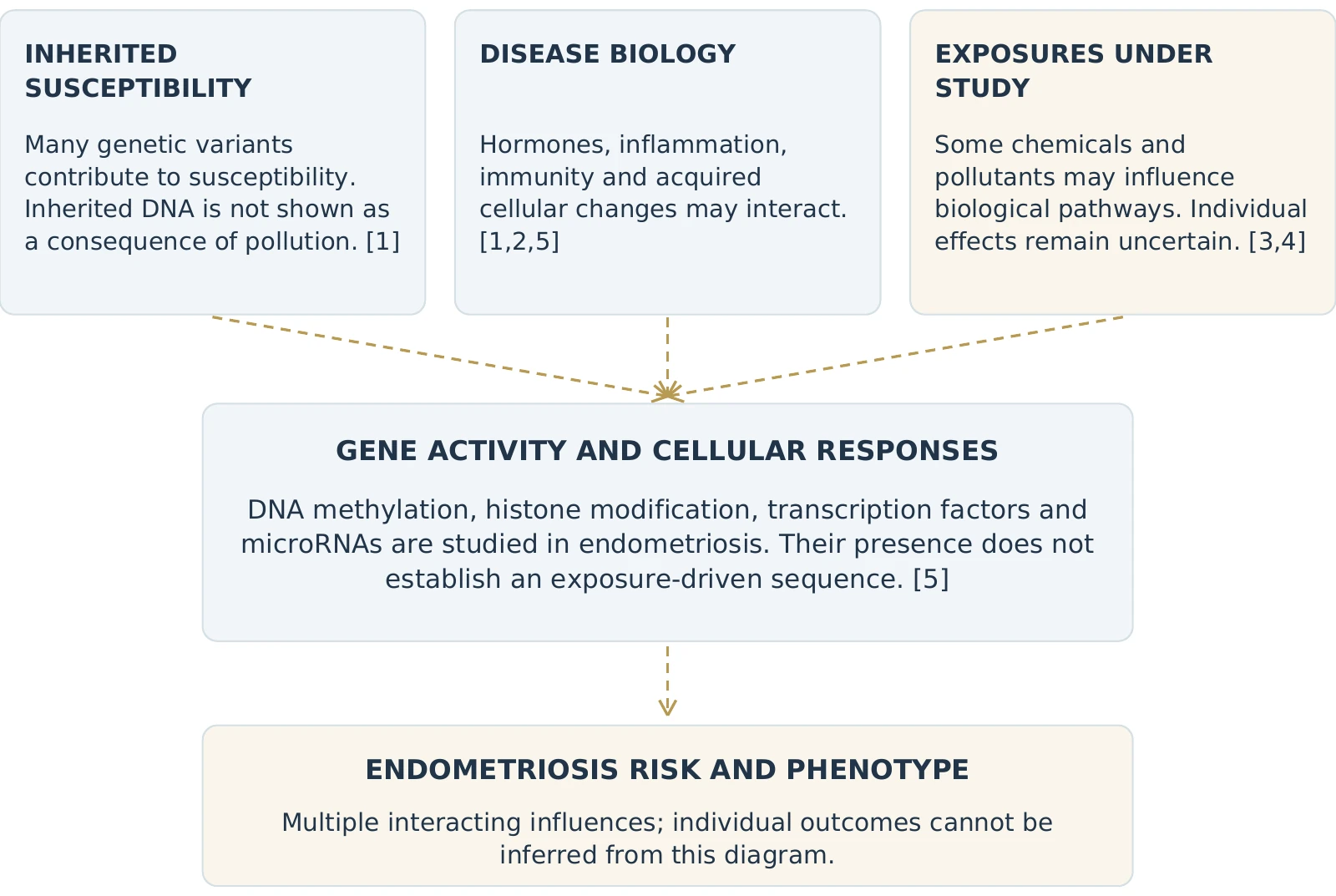
Diagram details
Diagram. Three boxes across the top, each with a dashed arrow pointing down to one central box. INHERITED SUSCEPTIBILITY: Many genetic variants contribute to susceptibility. Inherited DNA is not shown as a consequence of pollution. DISEASE BIOLOGY: Hormones, inflammation, immunity and acquired cellular changes may interact. EXPOSURES UNDER STUDY: Some chemicals and pollutants may influence biological pathways. Individual effects remain uncertain. Central box, GENE ACTIVITY AND CELLULAR RESPONSES: DNA methylation, histone modification, transcription factors and microRNAs are studied in endometriosis. Their presence does not establish an exposure-driven sequence. A dashed arrow leads from it down to the bottom box, ENDOMETRIOSIS RISK AND PHENOTYPE: Multiple interacting influences; individual outcomes cannot be inferred from this diagram.
Dashed arrows mark possible interactions. They do not prove that pollution changes inherited DNA, causes endometriosis, or transmits the disease across human generations.
Terms: DNMT = DNA methyltransferase; TF = transcription factor. Epigenetic regulation changes gene activity without necessarily changing the DNA sequence. microRNAs help regulate gene expression.
Evidence & interpretation
Genes, Environment and Endometriosis
Version 1.2 · September 2026
Genetic susceptibility
Rahmioglu et al. analyzed 60,674 cases and 701,926 controls and identified 42 loci with 49 distinct association signals. These associations support polygenic susceptibility, not a deterministic test for an individual.
Epigenetics and environment
The diagram combines possible mechanisms; it is not a proven chronological causal chain. Observational exposure associations and epigenetic findings do not show why a particular person developed disease. The epigenetic review is a 2025 publication, online in 2024.
Founder observation and treatment
The Founder's geographic impressions are retained as attributed personal observations, not independently measured epidemiology. Hormones can suppress activity and symptoms; they do not surgically excise lesions. Genetic or environmental findings alone do not establish the diagnosis.
What the microRNA sources actually show
Wei et al. (2015) addresses airborne pollution, microRNAs and lung inflammation/cancer. It supplies cross-disease background, not proof of endometriosis causation. Roush and Slack (2008) and Bartel (2009) are general microRNA reviews. They do not establish an endometriosis cause or a current ranking of the least-studied pathways.
Exposure across generations
During pregnancy, a mother (F0), her fetus (F1) and the fetus's developing germ cells (potential F2) can all be directly exposed. This is not by itself evidence of transgenerational inheritance. These sources do not establish a human exposure-induced, multigenerational endometriosis pathway.
Full references
- [1] Rahmioglu N, Mortlock S, Ghiasi M et al. The genetic basis of endometriosis and comorbidity with other pain and inflammatory conditions. Nat Genet. 2023;55(3):423-436. doi:10.1038/s41588-023-01323-z. PMID 36914876. Source
- [2] Becker CM, Bokor A, Heikinheimo O, et al. ESHRE guideline: endometriosis. Human Reproduction Open. 2022;2022(2):hoac009. doi:10.1093/hropen/hoac009. Source
- [3] Sirohi D, Al Ramadhani R, Knibbs LD. Environmental exposures to endocrine disrupting chemicals (EDCs) and their role in endometriosis: a systematic literature review. Rev Environ Health. 2021;36(1):101-115. doi:10.1515/reveh-2020-0046. PMID 32903210. Source
- [4] Wieczorek K, Szczęsna D, Jurewicz J. Environmental Exposure to Non-Persistent Endocrine Disrupting Chemicals and Endometriosis: A Systematic Review. Int J Environ Res Public Health. 2022;19(9):5608. doi:10.3390/ijerph19095608. PMID 35565013. Source
- [5] LE KN, Benor A, Decherney A. An update on epigenetic mechanisms in endometriosis. Minerva Obstet Gynecol. 2025;77(4):300-308. doi:10.23736/s2724-606x.24.05631-8. PMID 39625421. Source
- [6] Wei J, Li F, Yang J et al. MicroRNAs as regulators of airborne pollution-induced lung inflammation and carcinogenesis. Arch Toxicol. 2015;89(5):677-685. doi:10.1007/s00204-015-1462-4. PMID 25667014. [Background source] Source
- [7] Roush S, Slack FJ. The let-7 family of microRNAs. Trends Cell Biol. 2008;18(10):505-516. doi:10.1016/j.tcb.2008.07.007. PMID 18774294. [Background source] Source
- [8] Bartel DP. MicroRNAs: target recognition and regulatory functions. Cell. 2009;136(2):215-233. doi:10.1016/j.cell.2009.01.002. PMID 19167326. [Background source] Source
- [9] Heard E, Martienssen RA. Transgenerational epigenetic inheritance: myths and mechanisms. Cell. 2014;157(1):95-109. doi:10.1016/j.cell.2014.02.045. PMID 24679529. [Background source] Source
References link to the source article, bibliographic record or issuing organization. No listed institution endorses GEM.
Medical information
Do not delay care; seek emergency help for a suspected emergency.
This material is for educational purposes only and does not constitute medical advice or create a clinician-patient relationship with GEM.
© 2026 Global Endometriosis Movement. All rights reserved.